Find food near you

2026 Legislative Victories and What Remains Undone

2026 legislative victories and what remains undone

In response to staggering rates of hunger and federal cuts to vital food assistance, our communities rallied to pass policies that move us closer to ensuring everyone has the food we need to thrive.

As a result of our collective advocacy, Oregon lawmakers passed several key policies that protect our communities from the worst harms of the federal budget bill H.R. 1. As Oregon’s short session comes to an end, we’re celebrating these victories and we’re committed to continuing the work still needed to make sure all Oregonians can have food.

Hunger is on the rise in Oregon, and this legislative session was a critical opportunity for action

"My SNAP card balance was stolen in the month of October in 2025. I went to three food distributing sites. Out of these three sites, I was only able to get one package of chicken. Most of the food that I was able to acquire was either dry or canned food.
I wasn't able to acquire food that I can actually cook or that I usually eat, given that I'm a diabetic and I need to buy food that is healthy for me."
–Maria Delgado, Food for All Oregonians Advocate

"The cost of food has increased greatly, and as a mother it is very worrying since I'm forced to limit the food I buy for my children. I hope there is some action taken, and that they think about how this is affecting our families.”

—Multnomah County mother of three

Oregon faced a massive budget gap as a result of H.R. 1

Oregon entered this legislative session with a budget gap of about $750 million, primarily due to the combined impacts of H.R. 1’s burdensome new requirements to SNAP and Medicaid, as well as tax changes that overwhelmingly benefited the ultra wealthy

While Oregon can’t change federal SNAP rules, lawmakers faced and will continue to face important choices as to how to invest in Oregonians amid federal disinvestment.

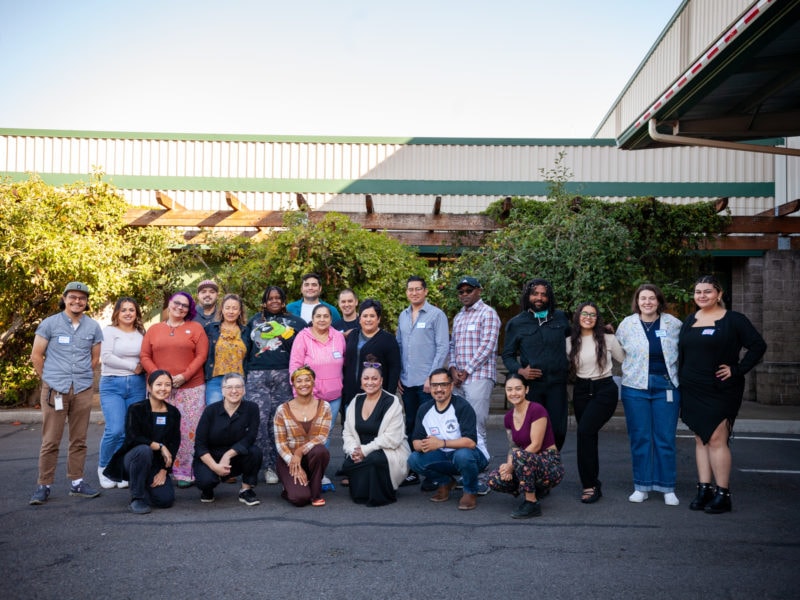
Our communities showed up

In response to high rates of hunger and harmful federal policies, we came together to advocate for the Anti-Hunger Package: state policies that address Oregon’s hunger crisis by protecting SNAP, supporting refugees and asylees, increasing access to free breakfast and lunch for students, and supporting Oregon’s Food Assistance Network.

As the federal government stripped away access to food assistance, Oregonians demanded that state lawmakers put our communities first.

  • 1,100 people contacted lawmakers

  • 150+ people traveled from all corners of Oregon to speak with legislators at an Advocacy Day in Salem

  • 70+ organizations and businesses signed on to support the Anti-Hunger Package

“I’m from Eastern Oregon, and I’ve seen how hunger shows up quietly, in skipped meals and hard choices. Hunger is a policy choice. What happens in Salem matters to families across the state.”

–Adrienne Sampson, member of Oregon Food Bank’s Policy Leadership Council

We’re celebrating policy wins that move us closer to ending hunger and addressing its root causes

Even amid a challenging budget environment, our collective advocacy helped achieve meaningful victories this session:

  • Protecting and Strengthening SNAP

    • We applaud the legislature for making critical investments in SNAP in response to H.R. 1. A $111 million investment will address new federal requirements while reducing harm to people who use SNAP to put food on the table. These investments will help Oregonians secure and keep SNAP benefits they are eligible for.

    • Oregon will also update SNAP cards to prevent benefits from being stolen from participants. We will continue to advocate for successful implementation of these measures and continue to advocate at a federal level to undo the many cruel policies in H.R. 1.

  • Support for Refugees & Asylees

    • The legislature approved $2 million for direct financial assistance for refugees, asylees and humanitarian immigrants who lost SNAP benefits due to H.R. 1, and who face the continued traumas caused by the federal administration. Support for immigrants and refugees has never been more critical.

  • Increase to the Earned Income Tax Credit

    • Lawmakers addressed affordability by increasing the state’s Earned Income Tax Credit by 5 percentage points.

    • The Earned Income Tax Credit is a refundable tax credit that puts money directly into the pockets of low- and moderate-income families. For a family of 3 earning $25,000/year, that’s an extra $340 starting next year.

  • Avoiding proposed cuts to food assistance

    • We thank the legislature for rejecting proposed cuts to food assistance, including a proposed $27 million cut to school meals and a proposal to pause efforts to make it easier for seniors to apply for SNAP. These cuts were avoided in part because legislators chose to partially disconnect from federal tax cuts enacted in H.R. 1, as well as a stronger-than-expected revenue forecast.

  • Strong response for immigrant justice.
    • We celebrate a major victory for immigrants in Oregon, as the majority of bills in the Immigrant Justice Package have passed!
    • The Immigrant Justice Package is one of the most substantial agendas for immigrant justice proposed in a single session in Oregon. These policies will support children whose parents have been detained, keep Oregon families together, protect hospital patients, ensure parents know when ICE is on school grounds, and more.

While we celebrate these victories, we are disappointed that several critical anti-hunger policies did not pass this session.

  • School Meals for All

    • Guaranteeing that breakfast and lunch are offered at school at no charge and with no questions asked is good for students, families, and schools. Oregon has made great progress in recent years to increase the number of schools offering free meals, but lawmakers once again failed to ensure passage of a statewide School Meals for All policy.

    • Kids who attend schools that don’t yet offer free meals will continue to be denied the positive educational, health, and social benefits of this policy. Additionally, about 90% of schools that currently offer free meals aren’t fully funded, which limits school districts’ ability to purchase fresh fruits and vegetables. We will continue to advocate for School Meals for All because all students deserve access to nourishing foods at school.

  • Oregon’s Food Assistance Network.

    • Rising demand and declining federal investment have created a statewide food assistance gap of approximately $25 million per year — a gap that philanthropy alone cannot fill. Unfortunately, the legislature did not choose to invest in these proven community-level solutions this session. As hunger in every part of Oregon rises, we will continue to urge the legislature to support community-level solutions to hunger.

There is more work ahead

Hunger is a policy choice. Oregon will face even bigger challenges and budget shortfalls next year because Congress and the federal administration chose to take away food and health care in H.R. 1.

Oregon can still choose how to respond. While we can’t undo all the harm created at the federal level, we still have power to do what’s right here in our state. We will continue to demand that our state budget cannot be balanced on the backs of people who are already struggling to afford food, rent, and health care. We will continue to urge our state to stand with immigrants and refugees who have been unfairly and cruelly demonized by this administration.

Food is more than just sustenance – it’s a bridge that connects us, strengthens our community, and fuels our potential. No one should fear where their next meal is coming from. Please let’s help our fellow Oregonians.”

–Margarita, Portland resident

We’re so grateful to everyone who joined us to make these meaningful victories possible this legislative session.

Thank you to our partners in this work: Adelante Mujeres, Afghan Support Network, ACLU-Oregon, AFL-CIO, American Heart Association, APANO, Catholic Charities of Oregon, Catholic Community Services of Lane County, Ecumenical Ministries of Oregon/SOAR, Ethiopian and Eritrean Cultural and Resource Center, Fair Shot For All, The Food For All Oregonians Coalition, FoodCorps, Innovation Law Lab, IRCO, Latino Network, Lutheran Community Services NW, Micronesian Islander Community, Northwest Workers’ Justice Project, Oregon Center for Public Policy, The Oregon Food Bank Network, Oregon Health Equity Alliance, Oregon Latino Health Coalition, Oregon Law Center, Oregon Nurses Association, The Oregon School Employees Association, The Oregon School Nutrition Association, Oregon Worker Relief, Our Children Oregon, Partners for a Hunger-Free Oregon, PCUN, Plaza de Nuestra Comunidad, Pueblo Unido, Salem for Refugees, SEIU Local 503, Working Families Party.

Take Action

Please join us in thanking our lawmakers for passing these critical anti-hunger policies and urging them to go further to help end hunger in Oregon.

CONTACT LAWMAKERS
Related posts

Policy Updates

Oregon Food Bank's 2026 Legislative Priorities

Policy Updates

The Oregon Food Bank 2026 State of Hunger Report: Food insecurity across Oregon and SW Washington

Policy Updates

How we’re fighting hunger in Oregon in 2026: The Anti-Hunger Package

Email sign-up

Stay connected

Sign up to receive emails with updates, resources and ways to get involved.