

“The impacted neighborhoods depend on infrastructure that was already struggling before the fire,” said Breen. “They didn't have safe water to drink. We were the first step of support, helping folks as they transitioned from the immediate disaster to long-term recovery.”
Ready to Respond: Columbia Gorge Food Bank on the front lines of Rowena Fire relief
Ready to Respond: Columbia Gorge Food Bank on the front lines of Rowena Fire relief
Ready to Respond: Columbia Gorge Food Bank on the front lines of Rowena Fire relief
When the Rowena Fire tore through the Columbia Gorge in June, families lost everything. In a community of just 130 people, where more than half were already living below the poverty line, 56 homes and nearly 100 other structures were destroyed.
“There are people in our community who went to work that day and have nothing,” said Breen Goodwin, Executive Director of Columbia Gorge Food Bank. “They had their clothes on their back and their vehicle, and they lost everything else.”
As climate change fuels more frequent and severe wildfires across our region, rural, low-income communities like Rowena tend to be hit the hardest. Columbia Gorge Food Bank, part of the Oregon Food Bank Network, was prepared to respond with emergency supplies right away, even while its own facility was under a Level 2 evacuation notice.
Just days after the fire started, the region’s Medicaid provider, PacificSource, asked Columbia Gorge Food Bank to deliver boxes of food and water to Medicaid recipients evacuated to hotels; many of the evacuees didn’t know whether their homes were still standing. Once the fire was contained, the food bank’s fleet of trucks delivered pallets of water directly to affected neighborhoods as residents returned to see what was left of their homes.
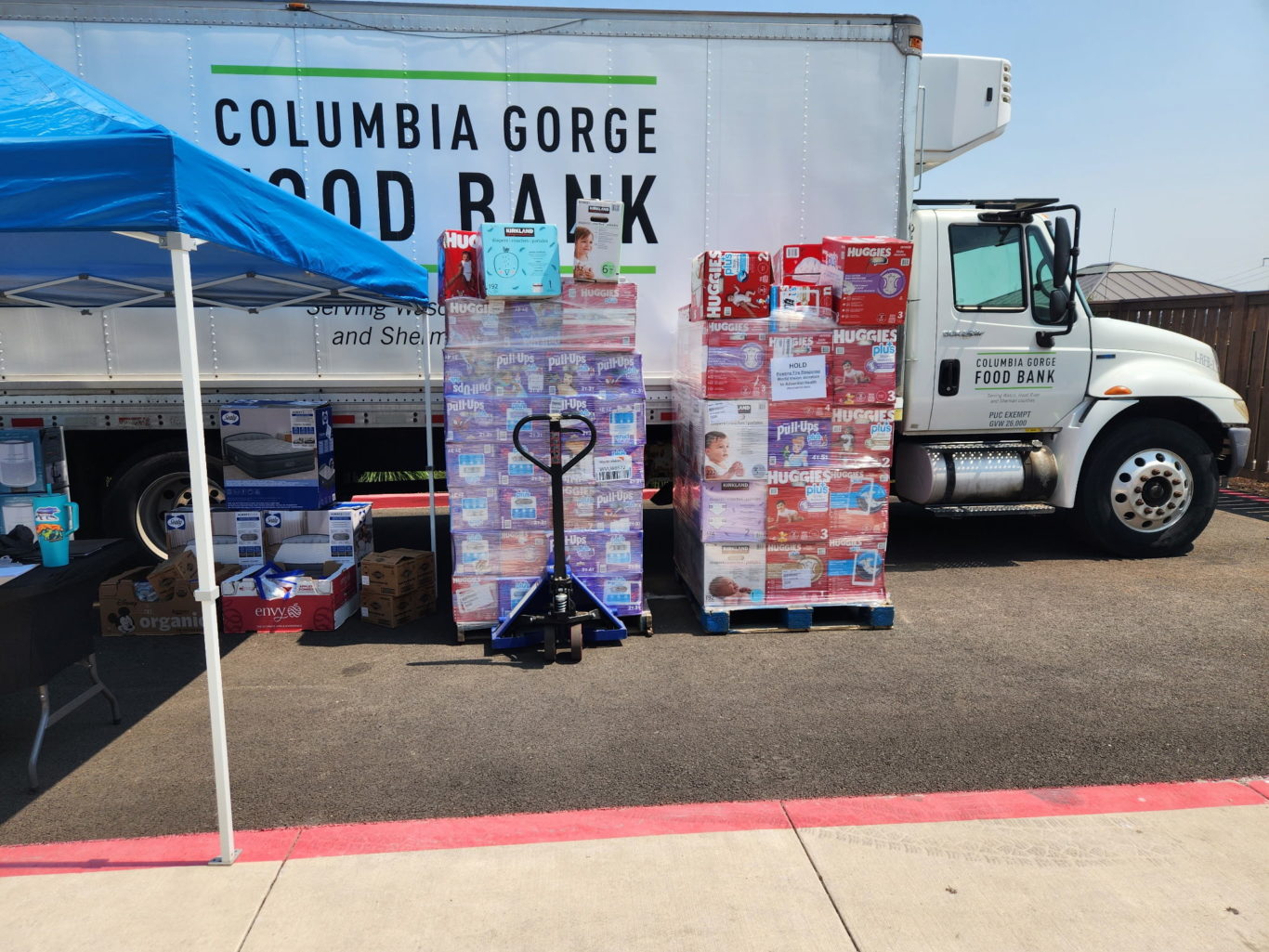
In the following weeks, Columbia Gorge Food Bank continued working alongside Wasco County Emergency Management and other partners to support displaced residents. This includes establishing recurring multi agency resource centers where residents could access several services in one place. In partnership with Adventist Health of the Columbia Gorge, Columbia Gorge Food Bank provided logistical support to store and distribute a full semi-trailer of donated supplies, including water, air purifiers, generators, hygiene kits, stuffed animals and more.
Columbia Gorge Food Bank responding with emergency supplies right after the Rowena Fire
Breen credits this rapid, coordinated responseto years of preparation. Columbia Gorge FoodBank’s new warehouse and community foodcenter, which opened in 2023, was designedfor crisis response — with expanded storage,a loading dock and box trucks.
“We got to leverage the facility for what it was built for,” she said. “It felt like we were fulfilling our mission, and our community got to see it in action.”
As part of the Oregon Food Bank Network, Columbia Gorge Food Bank receives and stores water and disaster boxes full of shelf-stable, ready-to-eat food and utensils. It also collaborates with Oregon Food Bank’s disaster response team, which meets 20 quarterly to coordinate across regional food banks and provides on-call support.


“We were ready for this,” said Breen. “We've been storing disaster boxes on site for the last year, and you never know when you're going to need them. But when you do, it's the most important inventory you have.”
Breen says that with climate change driving more frequent wildfires in the Gorge, her team will need to be ready again and again. Six of the last 10 years have been some of the driest in Oregon’s history, making fires faster and more destructive, especially in windy areas like the Gorge. These disasters not only devastate homes and farmland but also disrupt food supply chains, drive up prices and leave fewer fresh fruits and vegetables for our communities.
“The risk of fire really challenges the stability of our agricultural industry,” said Breen. “When a small farm burns, a farmer loses an entire harvest – and that affects our local food supply systems.”


Oregon Food Bank is working to prepare for these worsening climate impacts across the state. In the 2025 legislative session, Oregon Food Bank advocated for $10 million for Resilience Hubs & Networks (HB 3170) to strengthen Oregon’s ability to prepare for, provide relief from and recover from climate disasters. Lawmakers failed to pass this funding. The need remains high, and we are continuing to push for statewide solutions.
At the local level, Columbia Gorge Food Bank is replenishing its supply of water and disaster boxes, supporting its staff as they continue meeting the community’s ongoing needs and refining its response plans for future crises. Every gift helps make this critical work possible.
“You can support this work by giving to Columbia Gorge Food Bank or supporting your local regional food bank that is preparing for their own crisis response work” said Breen.
“It's our job to be ready, and we need your support to stay ready for the next crisis.”
— Breen Goodwin, Executive Director of Columbia Gorge Food Bank


Related posts

Community Voices
Words are policy: Why the language of hunger must change

Community Voices
On the move: How Elder Johnny Bradford expands food access across Oregon

Community Voices